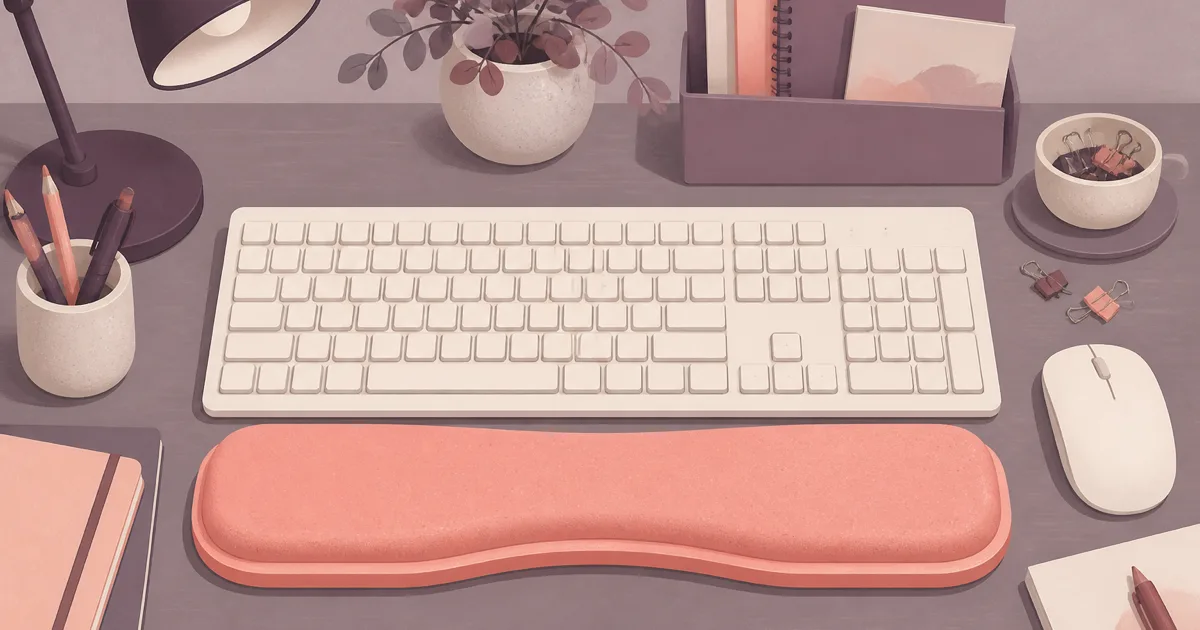
Wrist Rest for Keyboard: When It Helps and How to Size It
Desk accessories
A wrist rest for keyboard typing is a small front-edge pad, not a full desk mat. Match the height to your keys, then keep your wrists mostly floating while you type.
Our picks
A wrist rest is a small cushion that sits in front of the keys. It is not a full desk pad, and it is not the built-in palm rest on some ergonomic keyboards. The job is to give your hands a consistent place to land between sentences, without cranking your wrists into a sharp bend.
See the desk accessories category for more keyboard comfort gear.
If you have ongoing hand or wrist pain, treat this as comfort gear, not treatment. Numbness away from the desk needs a clinician.
When a wrist rest actually helps
It helps on a standard desktop keyboard with a raised front edge. Your palms want a matching height so you are not dropping off a cliff or climbing onto a thick brick.
It also helps if you take lots of short pauses (chat, thinking, waiting on a call) and you currently park your wrists on a hard desk edge. That edge is a worse rest than a padded strip.
It does not help if your real problem is desk height. If your shoulders are up and your elbows are floating, fix standing desk height or add a tray before you buy foam. A rest cannot lower a dining table.
How to size it in two minutes
Measure the front height of your keyboard, from the desk to the keycaps in the closest row. Then pick a rest in that neighborhood.
- Full-size desktop boards usually want a standard rest like the Kensington.
- Slim laptop keyboards often want a low-profile rest, or none.
- Mechanical boards with a high case need a taller rest, or you will still hit the case edge.
Width should cover the main typing cluster. A rest that is shorter than the keyboard leaves one wrist on wood. A rest that is much longer just wastes space under the mouse. Keep the mouse on its own zone, and consider a vertical mouse if forearm twist is the bigger complaint.
Hero pick: Kensington ErgoSoft for standard keyboards
The Kensington ErgoSoft Wrist Rest for Standard Keyboards is the rest to try first on a normal home-office board. The gel core stays supportive instead of turning into a pancake by Thursday. The curved shape is meant for a standard keyboard front, not a toy-sized compact. The base is supposed to stay put, which matters more than people think. A rest that creeps forward becomes a bump you fight.
Kensington also makes slim-keyboard versions. Buy the standard model only if your board is a typical desktop height.
Who it is for: Remote workers on a full-size or standard wireless keyboard who feel the desk edge during pauses.
Skip if: You already have a thick attached palm rest on an ergo board, or you type on a laptop with almost no front height.
Alternatives worth naming
Fellowes Memory Foam Keyboard Wrist Rest. A simpler foam pad if you want a lower price and a jersey cover. Foam feels immediately soft. It can lose loft. Use it when the Kensington is more rest than you need, or when you want a basic black pad that matches a quiet desk. View the Fellowes foam rest.
Built-in palm rest on an ergo keyboard. If you are already shopping for a split or curved board, that rest is part of the keyboard. Do not double up. Compare boards in the ergonomic keyboard guide first.
No rest at all. If your keys are low, your desk is at elbow height, and you already type with a light touch, skip the accessory. Plenty of people type well with floating wrists and a flat pad only.
How to use it without making things worse
Place the rest so the front of the keyboard just meets it. You should not have a gap you fall into, and you should not have to reach up onto a thick pillow.
Type with your hands mostly hovering. Let the rest catch you between bursts. If you feel yourself grinding the same spot all day, the pad is too high, too hard, or you are leaning on it like a shelf.
Keep it clean. Gel covers wipe. Foam covers collect skin oil. A grimy rest is one reason people decide the category "does not work."
On a sit-stand desk, the rest moves with the keyboard. That is fine. Recheck wrist line after you change height, because standing often changes how far you pull the board toward you.
Wrist rest vs desk pad vs tray
These three get searched as if they were the same product.
You can combine them. A tray that is too high still needs a height fix, not a thicker rest. A desk pad under a rest is normal. A rest glued to a bouncing tray is a waste.
Who should skip it
Skip if a clinician has you on a specific keyboard protocol. Skip if numbness wakes you at night. Skip if you have not set chair and desk height yet. The rest is a finishing piece, not the foundation. For the broader posture order, see home office ergonomic setup.
Bottom line
Buy a wrist rest for keyboard work when the key front is high enough that the desk edge hurts. Make the Kensington ErgoSoft the default for a standard board. Keep the Fellowes foam rest in mind if you want a simpler, cheaper pad. Match height, keep your wrists mostly floating, and fix the desk before you stack cushions. More desk guides are on the blog and the homepage.
Frequently Asked Questions
Should my wrists rest on the pad while I type?
Light contact between bursts is fine. Parking your full body weight on the pad through every keystroke is not. Type with floating wrists, then use the rest during pauses.
How tall should a wrist rest for keyboard use be?
Close to the front height of your keys. If the pad is much taller than the key row, your wrists bend up. If it is much shorter, you will ignore it.
Do I need a wrist rest if I already have a desk pad?
A desk pad is a large blotter. A wrist rest is a narrow cushion at the keyboard edge. You can use both. The pad is not a substitute if your keys sit high.
Gel or memory foam?
Gel stays more consistent in a warm room. Memory foam feels plush and can flatten. Pick gel if you type long days; pick foam if you want a cheaper, softer pad.
Will a wrist rest fix carpal tunnel?
No. It is a comfort accessory. Numbness, night pain, or symptoms away from the desk need a clinician, not a new pad.
Can I use one with an ergonomic split keyboard?
Only if the rest matches the keyboard width and front height. Many split boards already include a palm rest. Do not stack a second pad in front of that.
Does it belong on a keyboard tray?
Sometimes. The tray still has to be wide enough. If the rest makes the tray bounce, skip it and fix tray stability first. See keyboard tray for desk.