Best Office Chair for Tailbone Pain (2026): 3 Picks That Take the Pressure Off
Office chairs
A tailbone-friendly chair comes down to foam you do not sink through and a seat you can shift in. The Nexthro is the best all-round pick, the Marsail adds a headrest, and the Everlasting Comfort cushion adds the cutout a flat seat lacks.
Our picks
The best office chair for tailbone pain for most people is the Nexthro Ergonomic Office Chair, because the wide, thickly padded seat lets you sit back without your coccyx carrying your weight. Browsing office chair guides is a good next step, and the best office chair pillar covers fit and sizing if you are starting from scratch.
A sore tailbone is not a vague back ache. It is a pinpoint pressure under the very bottom of your spine, and it gets worse the longer you stay in one position. Chairs rarely fix it on their own because the part of the seat your coccyx lands on is exactly the part a flat cushion or a tight mesh seat presses hardest.
The good news is that this is a mechanical problem, so it has a mechanical answer. Move the pressure, and most people get relief within a few days of sitting.
If the pain runs down a leg instead of staying in one spot, read the sciatica guide alongside this one. If it sits higher, around the belt line, the best lumbar support for office chair page is the better fit. One more related job, the tailbone cushion, is covered in our seat cushion for office chair guide.
What actually takes pressure off a tailbone
Your coccyx is a small triangle of bone with almost no padding over it. When you sit, it should rest just behind your two sit bones, not underneath your body weight. Three things push it back into the seat:
- Firm, flat foam. A thin seat pad bottoms out under load and your tailbone lands on the hard base underneath.
- A seat that is too deep. If the seat edge hits the back of your knees, you slide forward, and that rolls your pelvis back onto the coccyx.
- No cutout. Nothing to suspend the tailbone, so it stays in contact all day.
A chair can fix the first two points with deeper foam and a shorter seat depth. Only a cushion with a U-shaped or V-shaped opening solves the third, which is why this guide pairs two chairs with one cushion.
The three picks at a glance
Best overall: Nexthro Ergonomic Office Chair
The Nexthro Ergonomic Office Chair is the pick for most people because of what is under you rather than what is behind you. The seat runs 20.9 inches wide and 20.7 inches deep with 3.2 inches of high-density foam, and the depth matters more than the width here. A seat that stops just behind your knees lets you keep your feet flat and your pelvis upright instead of sliding forward onto the tailbone.
The backrest is a breathable double-layer mesh with a lumbar pad that adjusts roughly an inch forward and back and about three inches up and down. That range is what lets you find the spot that keeps your lower back neutral, which takes some of the load off the coccyx even though the pad does not touch it.
The frame is rated to 400 pounds, which is unusual at this price, and the listed fit runs from about 5'4" to 6'3". Assembly takes most people 15 to 20 minutes with the included tools.
Honest limits: the chair has fewer than 200 ratings, so we cannot point to a five-year track record the way we can with the Marsail. The armrests adjust in steps and do not lock in as many positions as a premium chair. And like any mesh-back chair, the seat is where the long-term comfort lives. If your foam flattens in a year, a cushion is the cheap fix.
Check it: Nexthro Ergonomic Office Chair on Amazon
Best with a headrest: Marsail Ergonomic Office Chair
The Marsail Ergonomic Office Chair is the pick when you want to lean back. The high mesh back plus headrest gives your neck somewhere to go during a long call, and the 90 to 120 degree recline lets you break up a sitting session without leaving the desk.
The seat is about 3.1 inches of foam over a mesh base, rated to 330 pounds, with 3D armrests that flip up. The lumbar pad moves up and down over roughly a 2.4-inch range and adjusts forward and back, which helps if your lower back needs more contact than the default position gives.
Where it falls short is depth. Once you have the lumbar where you want it, you cannot fine-tune how hard it presses, so if you have a pronounced curve the pad may sit behind your back instead of into it. Armrest padding is polyurethane, and reviewers who have owned the chair for a year report it cracking and flaking around the edges. The headrest also does not follow a full recline, so tall users tend to find it more decorative than supportive.
That is a fair trade at this price. You are buying adjustment and a headrest, not upholstery that lasts a decade.
Check it: Marsail Ergonomic Office Chair on Amazon
Fix the chair you already own: Everlasting Comfort seat cushion
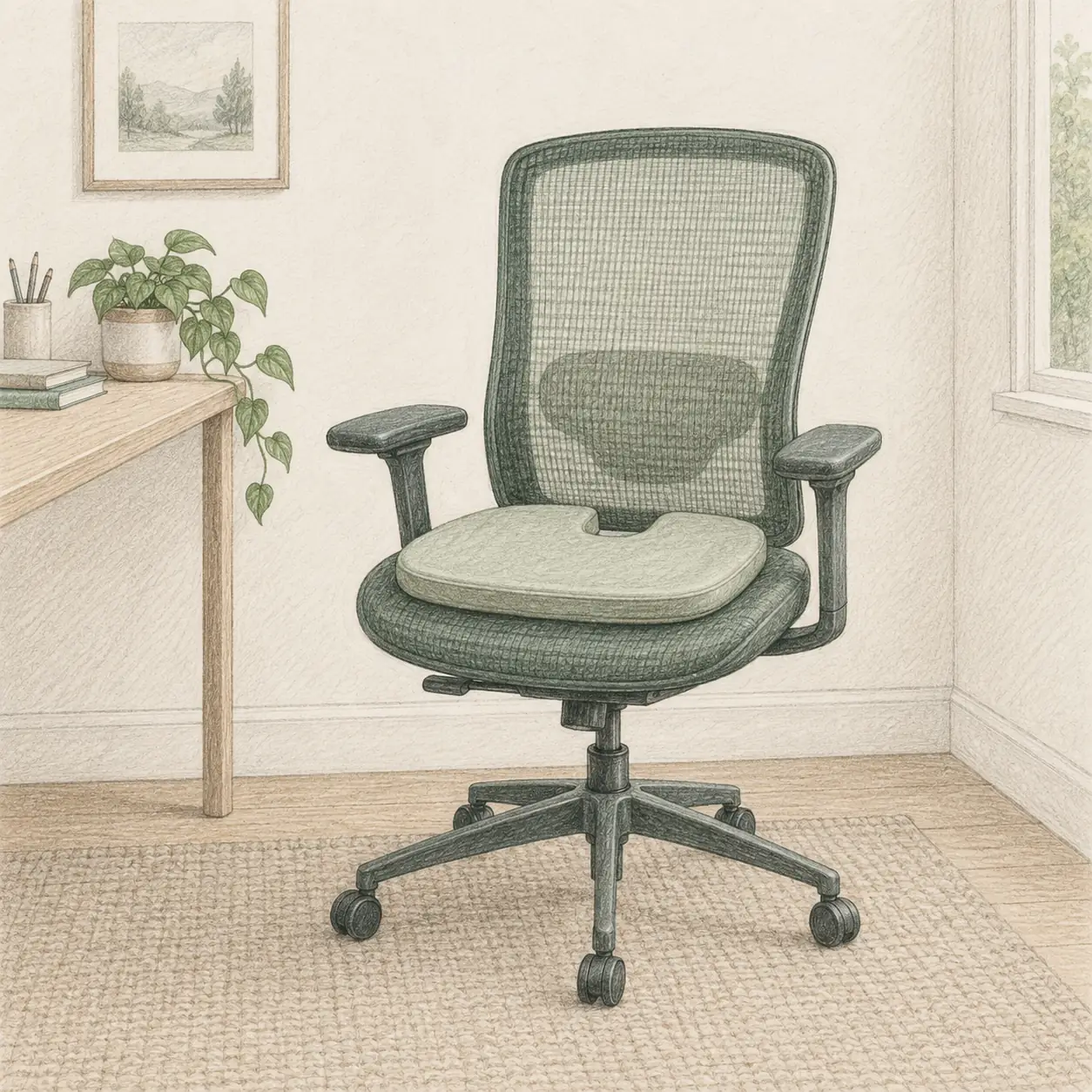
The Everlasting Comfort seat cushion does the one thing the two chairs above cannot. Its U-shaped cutout removes the foam directly under your coccyx, so your weight lands on your sit bones and thighs while the tailbone hangs in the opening. Relief from that geometry is mechanical, not gradual, which is why it is worth testing before you spend $140 on a chair.
It is 3 inches of gel-infused memory foam with a breathable cover that comes off for washing, and it fits a desk chair, a dining chair, or a car seat. That portability is why it shows up in tailbone threads over and over, and why it works as a diagnostic: if a week on this cushion fixes your afternoons, you have confirmed the problem is pressure rather than posture.
Two honest caveats. Memory foam compresses over months, and users who sit eight hours a day report the relief fading after a couple of months of daily use, so treat it as a consumable rather than a permanent fix. And that 3-inch lift changes your desk geometry. If your feet stop reaching the floor, add a footrest before you blame the cushion.
Check it: Everlasting Comfort seat cushion on Amazon
Seat depth, sit bone width, and your coccyx
Fit beats features on a tailbone-friendly chair, and two measurements do most of the work.
Seat depth. Sit all the way back. You want two to three fingers of space between the seat edge and the back of your knees. Deeper than that and you slide forward, which rolls your pelvis back onto the coccyx. Shorter than that and your thighs take all the pressure.
Sit bone width. Your two sit bones should land on foam, not on the seat's side bolsters. A seat around 20 inches wide suits most adults, which is why the Nexthro's 20.9 inches is the number we lead with.
Seat height. Your feet should rest flat and your thighs should be roughly level. A cushion that lifts you three inches often breaks this, so lower the chair when you add one.
If your current chair fails the depth test, no cushion will fully rescue it. That is the point where the best ergonomic office chair guide is more useful than another pad.
When a new chair is not the answer
Sometimes the chair is not the problem, and buying another one just moves the pain.
- You sit for three hours without standing. No seat fixes a position you never leave. Stand up every 30 minutes, even for a minute.
- Your wallet is behind you. A chair cannot undo a back pocket pressing into one side of your pelvis all afternoon.
- You perch on the front edge. That position puts your full weight on the coccyx. Slide back until the seat supports your thighs.
- Your desk is too high. If you raise the chair to reach the keyboard, your feet leave the floor and your thighs tilt up. Lower the desk or add a footrest.
- The pain is not pressure-shaped. If it burns, shoots, or wakes you at night, that is a clinical question rather than a furniture one.
Which pick fits your day
Buy the Nexthro if you sit most of the workday, want a wide foam seat, and do not need a headrest. It gives you the most pressure-friendly seat for the money.
Buy the Marsail if you lean back often, take calls in the chair, and want armrests that get out of the way. It is the better all-round chair, with the caveat that the lumbar pad is height-only.
Buy the Everlasting Comfort cushion first if you are not sure the chair is the problem. It is the cheapest test of whether pressure relief is all you needed, and it keeps working on whatever chair you buy next.
Pair the cushion with a footrest if the lift leaves your feet dangling, and read the best office chair for hip pain guide if the ache sits to one side rather than at the very base of your spine.
Bottom line: The Nexthro Ergonomic Office Chair is the best office chair for tailbone pain for most people because of its deep foam seat and adjustable lumbar. The Marsail adds a headrest and flip-up arms for leaning back. And the Everlasting Comfort seat cushion is the fast, cheap way to find out whether a coccyx cutout is all your chair was missing.
Frequently Asked Questions
What should I sit on if my tailbone hurts?
Start with a cushion that has a real cutout at the back, because that is the part that removes pressure from the coccyx. If the pain is still there after a week or two of sitting that way, the chair seat itself is probably too firm or too flat, and the Nexthro or Marsail picks give you more foam and a seat you can shift in.
Why does my tailbone hurt in my office chair?
The base of your spine carries almost no body weight when you sit upright on a seat that fits. It hurts when a firm, flat seat presses straight into the coccyx, when you slide forward and slump, or when you sit for hours without changing position. A cutout cushion, a softer seat, and standing up every 30 minutes all attack the same problem.
Is there an office chair with a coccyx cut-out?
Cutouts are rare on chairs at this price and much more common on cushions. The chairs in this guide help by giving you deeper foam and a seat you can move in, and the Everlasting Comfort cushion adds the cutout on top of whatever chair you already own.
What is the best tailbone cushion for a desk chair?
One with a U-shaped or V-shaped opening that sits far enough back to clear your coccyx once you settle in. The Everlasting Comfort cushion is the version we recommend here because the non-slip base holds the cutout in place instead of letting it drift forward through the day.
Does a cutout cushion help if I also have sciatica?
It can. Taking pressure off the tailbone also takes pressure off the soft tissue around it, which is where sciatic irritation often starts in a chair. If the pain shoots down a leg, also read our office chair for sciatica guide so you address the seat angle as well as the pressure point.
How thick should a coccyx cushion be?
Around 2 to 3 inches is the useful range. Thicker cushions lift your hips so far that your forearms no longer sit level with the desk, which trades tailbone pain for shoulder strain. If a cushion leaves your feet dangling, add a footrest.
Do I need a chair with a cutout, or is a cushion enough?
A cushion is usually enough, and it is far cheaper to test. Buy the chair when the seat foam is collapsing anyway, when you want a headrest for breaks, or when you have already tried a cushion and your sit bones still ache after an hour.
Can a mesh seat make tailbone pain worse?
Mesh can, if the tension is tight across the front edge and your thighs take all the pressure. A mesh back is usually fine because it only touches your spine. If the seat is the problem, a foam cushion over the mesh gives you the airflow with a softer landing.
What if the pain does not improve?
A cushion and a chair manage pressure, they do not treat an injury. If sitting still hurts after you have changed the seat, if the pain started with a fall, or if it is getting worse, see a clinician rather than buying another chair.