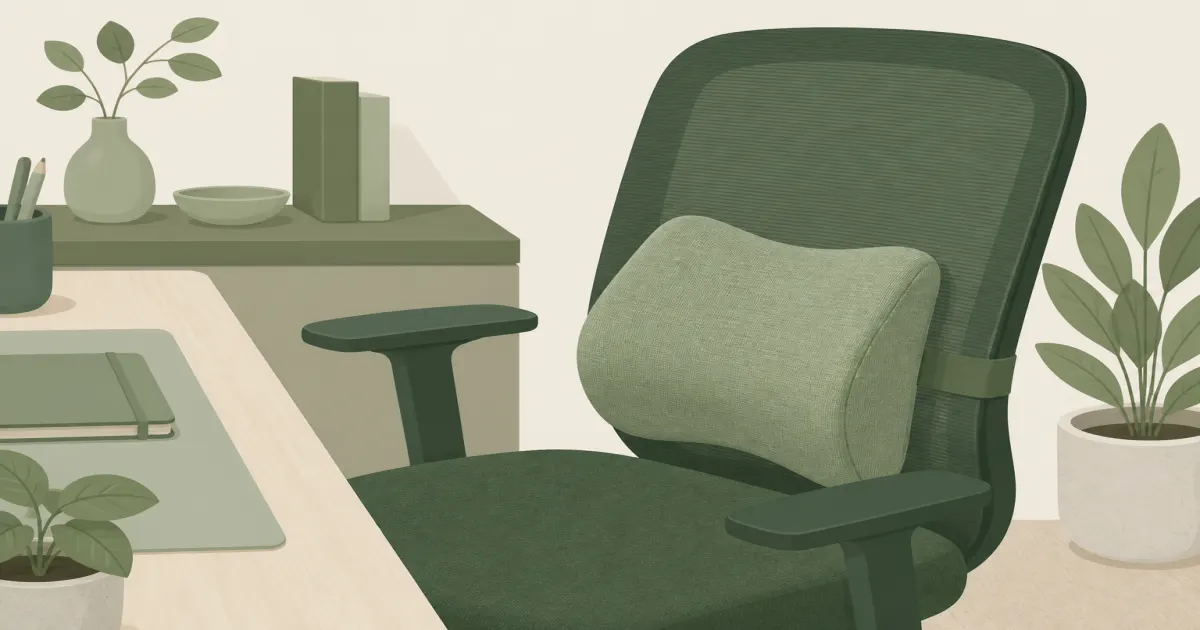
Best Lumbar Support for Office Chair (2026): Picks That Stay Put
Office chairs
The best lumbar support for most office chairs is the ComfiLife Lumbar Support Back Pillow for flat task-chair backs. Switch to Everlasting Comfort when a single strap will not grip a wide or contoured backrest, or to the TRALT chair when you want adjustable lumbar built in.
Our picks
The best lumbar support for an office chair is a firm, strapped pillow that fills the lower-back gap and stays put through a full workday. Most people searching for "lumbar support" or "back support" want the same thing: padding that meets the curve above their hips and does not slide the moment they recline.
One rule decides whether the pillow works: the thickest part has to sit two to three inches above the seat pan. Get that height wrong and even a $40 pillow feels useless.
Browse the office chairs category if the seat itself is the real problem, or start with our best office chair guide when you are ready to change the frame. For sharp or lasting pain, talk to a clinician. A pillow offers comfort, not medical treatment.
Where should a lumbar pillow sit on an office chair?
Set the thickest part of the pad about two to three inches above the seat pan so it meets the lumbar curve. If it lands between your shoulder blades, it is too high to help and will push your mid-back forward.
Getting that height right is most of the benefit. On a typical task chair the seat-to-shoulder distance is around 17 to 19 inches, and the lumbar curve sits in the bottom quarter of that. A full-backrest pillow is built for a sofa, where the seat is deeper and the back is taller. On a desk chair it rides up.
How to find the spot on your own chair
Sit all the way back so your hips touch the chair. Slide your hand behind you until you feel the hollow just above your belt line. That hollow is where the pad's thickest point belongs.
What to do if the pad pushes you forward
A pad that shoves your shoulders off the backrest is too thick for that chair rather than badly placed. Move it down an inch, then try a thinner cushion. If neither works, the seat is probably too deep and the chair is the real problem.
How long before you judge the placement
Give it a full afternoon. Many people return pillows after five minutes that would have felt fine after an hour of small adjustments. Move it an inch at a time and recheck after lunch.
What good placement feels like at each height
Use this as a quick check. The pad should feel like gentle pressure in the hollow of your lower back, never like a hand pushing your chest forward.
When a lumbar pillow is enough
Use a lumbar pillow when the chair is otherwise fine: seat height works, seat depth is close, and you only miss lower-back contact. Skip it when the seat is much too deep or the backrest never meets you. In that case, start with a better ergonomic office chair or a cooler mesh office chair instead of stacking cushions.
Also check posture basics. Feet supported, hips slightly above knees, elbows near desk height. A pillow cannot fix a desk that is too high. Pair this with standing desk height if the whole setup is off.
Should office chairs have lumbar support?
Yes. A chair with adjustable built-in lumbar does the job a pillow only imitates, because the pad moves to your curve instead of you moving a cushion to meet it. A pillow is the fix when the chair has no lumbar or only a thin fixed pad.
When built-in lumbar is worth the money
Built-in lumbar is the better choice when the pad can move up, down, and in, and the seat depth and arm fit already work for you. It is worth the extra spend when you would otherwise buy a chair plus a $37 pillow and still fight a seat that is too deep. It is not worth it when the chair's only lumbar is a fixed plastic bulge that lands in the wrong spot.
How to adjust the lumbar on a built-in chair
Find the height lever or dial first, set the pad in your lower-back hollow, then add depth a turn at a time until your shoulders still rest on the back. On most chairs the height slider is under the seat edge and the depth knob is on the backrest side. Nudge it while seated, not before you sit.
How to test the lumbar on a chair before you buy
Sit all the way back and slide a hand behind your lower back. If the pad sits in the hollow above your hips and you can move it to keep it there, it will hold. If the pad lands at your shoulder blades or will not move at all, the chair is a pillow waiting to happen.
Hero pick: ComfiLife lumbar pillow
The ComfiLife Lumbar Support Back Pillow is the hero for most flat or weakly curved chair backs. Contoured memory foam, a breathable mesh cover, and an adjustable strap cover the usual home-office chairs. It sits at 4.4 stars across 11,641 ratings on Amazon, one of the most-reviewed lumbar pillows in this lane. Firmness and strap fit are the usual split. Some people want more fill. Others feel shoved forward. Move it an inch at a time through a full afternoon.
Set the strap so the thickest part sits in your lumbar curve, not under your shoulder blades. Sit for a full afternoon before you decide.
Who it is for: Task chairs and car seats with a flat lower back and a backrest the strap can wrap.
Shop: ComfiLife lumbar pillow on Amazon
Dual-strap alternative: Everlasting Comfort
If ComfiLife's single-strap layout will not grip your chair, look at the Everlasting Comfort Lumbar Support Pillow for Office Chair. It is the dual-strap alternative many buyers already know, with a firm foam core that holds shape through long sits. It carries 4.4 stars over 37,670 ratings, the most-rated of the three picks.
Choose Everlasting Comfort when the chair back is wide, contoured, or hard to wrap with one elastic strap. Choose ComfiLife when you want a cooler mesh cover and a slightly more compact contour. Neither pillow replaces a chair with real seat depth and arm fit.
Shop Everlasting Comfort lumbar
Best built-in lumbar chair: TRALT Office Chair
The TRALT Office Chair is the pick when the chair itself, not the pillow, is the real problem. It has a lumbar pad that moves up and down and sets its own depth, a mesh back, and a molded high-resilience foam seat at around $120. It is rated 4.3 stars across 4,948 ratings and a Class 3 gas lift that resists the slow sink that cheap cylinders develop.
Who it is for: A first home-office chair with adjustable lumbar, or a replacement for a cheap seat that is being propped up with a pillow.
Skip if: You want a plush executive feel. The mesh back is firmer and cooler than a padded chair.
How the three picks compare
The chair costs more up front, but it replaces a chair and a pillow at the same time. If the seat depth and arm height are already wrong on your current chair, that trade makes sense.
How much does a lumbar pillow cost to own?
At $37.45, the ComfiLife works out to about 3.4 cents a day over three years. The Everlasting Comfort at $39.99 is about 3.7 cents a day over the same span. Both are cheaper than the chair they are propping up.
The reason to pay more than $20 is the foam. Low-density foam collapses by lunch and leaves you hunting for a second cushion by month three. The two picks above hold their shape because the foam is dense enough to resist compression.
How far does a single strap actually reach?
A single strap works on a backrest up to roughly the width of a standard task chair, about 20 inches. Past that, the band stretches, the pad slides, and the pillow ends up at your mid-back by the afternoon. Dual straps with extenders are the fix, and they are the only reason to choose the Everlasting Comfort over the ComfiLife.
Why the cover decides whether you keep using it
A mesh cover runs cooler and unzips for washing. A soft fabric cover feels nicer in a cold room but holds heat and shows wear sooner. If you sit for more than four hours a day, the mesh side matters more than the texture.
Setup checklist
- Sit all the way back so your hips touch the chair.
- Place the thickest part of the pillow about two to three inches above the seat pan, in the lumbar curve.
- Tighten the strap so it cannot slide down when you recline.
- Recheck after a full workday and move it one inch at a time.
If the pillow pushes you forward until your shoulders leave the backrest, it is too thick for that chair. Try a lower placement or a different chair. For short sitters, also see office chair for a short person.
Firmness, heat, and all-day sitting
Memory foam that feels perfect for ten minutes can feel too hot by hour three. Mesh covers help. If you still run warm, loosen layers or open a window before you blame the pillow. Soft, mushy foam that collapses by lunch is the opposite problem. Judge firmness at hour three, not in the first ten minutes.
Wash the cover on a gentle cycle when it gets shiny from shirts. Zip covers that remove cleanly are easier to keep. Foam cores that cannot air out after a spill should be returned.
The temperature point surprises many people. Memory foam is heat and weight responsive, so a pillow that felt perfect in a warm room can feel like a brick in a cold one until your body heat works into it. Give it ten minutes before you decide it is too firm.
What is the best lumbar support pillow for a recliner?
For a recliner, choose a thinner strapped pillow with a long band that wraps the wider back, and keep the thickest part in the hollow above your hips. A pillow built for a desk rides too high on a recliner, and a loose cushion slides when the seat tips back.
Recliner backs are usually wider and flatter than a task chair, so strap reach matters more than contour. If the band will not reach around, the Everlasting Comfort's extenders do the job. Avoid a full-backrest sofa cushion: on a recliner it lands between your shoulder blades, which is where you least want pressure when the seat tips back.
The same logic covers car use. If the strap fits a bucket seat and the foam clears the shoulder belt, a desk pillow can work in a car. Test it on a short drive first.
Signs you need a new chair instead
Replace the chair when the seat is much too deep, the armrests never clear the desk, or the backrest will not meet your shoulders no matter where the pillow sits. A lumbar cushion cannot shorten a seat pan. It also cannot add a seat-depth slider that is not there. Pressure under you is a different product. Compare a seat cushion for office chair instead of stacking more back pillows.
If lower-back pain is the main complaint and the chair already has a strong lumbar knob, try adjusting that before you add foam. Built-in lumbar that hits your curve beats a floating pillow. Use the pillow when the built-in pad is thin, fixed in the wrong spot, or missing entirely. For a full fit checklist, see office chair for back pain.
Budget chairs can still work with a good pillow for a while. Just treat the pillow as a test. If you need three cushions to survive a workday, spend the money on a better budget office chair or a more adjustable mesh model. Hip pain sits in a different spot, so office chair for hip pain is the better fit if that is the real complaint.
Bottom line
Start with the ComfiLife lumbar pillow when you need firm, washable lower-back fill on a typical task chair. Switch to Everlasting Comfort when dual straps fit your backrest better. If the seat depth or armrests are wrong, fix the chair instead of collecting cushions.
Frequently Asked Questions
What is the best lumbar support for an office chair?
The ComfiLife Lumbar Support Back Pillow is the best lumbar support for most office chairs with a flat or weakly curved lower back. Choose Everlasting Comfort when you need dual straps for a wide or contoured backrest.
What is the best ergonomic lumbar support for an office chair?
Ergonomic here means the padding sits in the curve above your hips and holds its height. The ComfiLife does that on a typical task chair, and the Everlasting Comfort does it on wide or contoured backs where one strap will not grip.
Back support vs lumbar support: what is the difference?
For desk chairs, both terms usually mean the same thing: lower-back fill that sits in the curve above your hips. A full-backrest pillow that rests between your shoulder blades is the wrong height for an office chair.
Where should a back support pillow sit on an office chair?
Place the thickest part in the small of your back so your pelvis stays upright. If it pushes you forward, lower it or choose a thinner cushion so your shoulders still touch the backrest.
How high up the backrest should a lumbar pillow sit?
Aim for the pad's thickest point about two to three inches above the seat pan, which lands it in the lumbar curve. On a typical task chair that is roughly a hand's width above the seat cushion, well below the shoulder blades.
Why does my lumbar pillow feel firm in winter and soft in summer?
Memory foam is heat and weight responsive, so the same pillow changes firmness with room temperature. A cold office makes it feel harder on day one; ten minutes of body heat softens it.
Will a lumbar pillow fix a bad office chair?
Only partly. A pillow fills a gap. It cannot fix a seat that is too deep, armrests that block the desk, or a backrest that will not recline. See office chair for back pain if the chair itself is the real problem.
How do I stop a back pillow from sliding down when I recline?
Tighten the strap so the pillow cannot travel, and check the buckle after a full workday. Dual straps or a longer wrap fix wide gaming backs and thick task chairs. If the strap is at its limit, switch to the Everlasting Comfort alternative.
Memory foam or mesh cover: which stays cooler?
Mesh runs cooler for long sessions and usually has a removable washable cover. Soft fabric can feel nicer in winter. Either way, pick a cover you can unzip and wash.
Should I get a chair with built-in lumbar or a pillow?
Built-in lumbar is the better choice when it actually hits your curve and you can adjust height or depth. A pillow is the better choice when the chair has no lumbar, the knob only moves a thin plastic pad, or you sit in more than one chair each day.
What is the best lumbar support chair for office use?
The TRALT Office Chair is the best value if you want adjustable lumbar built in at around $120. It has a movable pad that sets depth and height, and its flat molded-foam seat still takes an add-on cushion if you want more.
Should office chairs have lumbar support?
Yes. A chair with adjustable lumbar does the job a pillow only imitates, because the support moves to your curve instead of you moving a cushion to meet it. A pillow is the fix when the chair has no lumbar or only a thin fixed pad.
Can I add lumbar support to a chair that has none?
Yes. A strapped pillow is the usual fix, and it works best when the seat depth and arm height are already close. If the seat is too deep or the arms block the desk, no cushion fixes that, so put the money toward the chair.
Can I use the same back pillow in my car?
Often yes if the strap fits and the foam does not block the shoulder belt path. Test it on a short drive before a long commute, and avoid loose foam that can slide under you during a hard stop.
What is the best lumbar support pillow for a recliner?
Pick a thinner, strapped pillow with a long band that reaches around the recliner back, and keep the thickest part in the hollow above your hips. A full-backrest cushion built for a sofa rides too high in a desk or recliner seat.