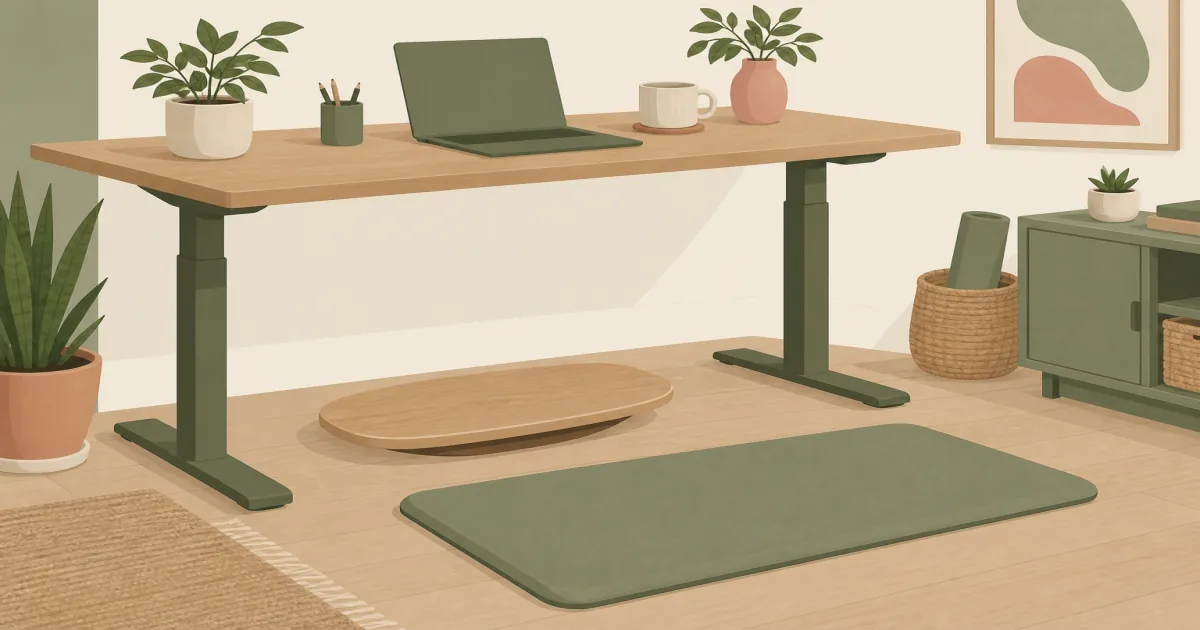
Best Balance Board for Standing Desk (2026): Quiet Movement Picks
Standing desks
The best balance board for a standing desk is the StrongTek wooden rocker for short movement blocks, paired with the Topo mat when you want cushion without the rocker challenge.
Our picks
The best balance board for a standing desk is the StrongTek wooden rocker when you want real movement without chasing a loose roller. The Topo mat is the calm half of the same kit: cushion and subtle terrain when a rocker asks too much.
A standing desk fixes sitting. It does not automatically fix stiff ankles. A lot of people raise the desk, plant both feet, and recreate the same frozen posture they had in a chair. A balance board keeps your lower body lightly busy while your hands stay on the keyboard.
It is not magic cardio. It is a standing-desk accessory with a clear job: add small movement underfoot so you are less likely to lock your knees and quit standing by lunch.
If you mainly want softer flooring, start with an anti fatigue mat for standing desk setup. If you want a walking option, see under desk treadmill gear. A board sits between those two: more active than a mat, less of a machine than a walking pad. Browse the standing desks collection when you are ready to compare frames.
Is a balance board good for a standing desk?
For most healthy people, yes, in short blocks. A board keeps your feet and ankles shifting instead of locked, which is the exact habit that makes standing feel tiring by mid-morning. It is not a workout and it will not replace walking.
The reason it helps is simple. Standing still is the problem, not standing itself. When both feet are planted and your knees lock, the same muscles hold the same position for an hour. A rocker interrupts that. You shift weight, your calves wake up, and standing starts to feel like something you can do longer than fifteen minutes.
You do not need a fancy board to get that effect. You need a base that tilts and a deck wide enough to stand on normally. That is why the two picks here are a plain wooden rocker and a contoured mat rather than a gym-grade wobble platform.
Do balance boards really work?
They work as movement prompts, not as fitness gear. A board makes you shift weight and use your ankles while you type, so your legs stay lightly active and you are less likely to freeze into one stance. It will not build strength on its own, and it will not replace a walk.
Are balance boards safe to stand on all day?
No, and you should not try. Start with 10 to 15 minutes per block and build over a week or two. All-day board standing on day one is the fastest way to decide the whole category is silly. Hold the desk edge while you learn, and skip the board if you have balance, ankle, or inner-ear problems.
What does a board actually change about your stance?
It interrupts the lock. When both feet are still and your knees straighten, the same muscles hold the same position for an hour. A rocker makes you shift weight and use your ankles, so standing becomes a series of small adjustments instead of one long freeze.
What is the 20-8-2 rule for standing desks?
The 20-8-2 rule means 20 minutes sitting, 8 minutes standing, and 2 minutes moving, repeated through the hour. It is a simple way to break up a desk day, and a balance board fits neatly into the 8-minute standing block while a short walk or stretch covers the moving minutes.
That ratio matters more than any single accessory. If you stand for a full afternoon on day one, your feet and lower back will complain no matter how good the board is. The rule spreads the load. You sit for most of the hour, stand for a short block, and move for a couple of minutes.
A board makes the standing block easier to fill. Instead of planting your feet and watching the clock, you rock gently and the eight minutes passes without you noticing. When the block ends, you sit or step onto the mat.
What are the downsides of using a balance board?
The honest downsides are a wobbly first session, a little desk space given up, and a hard base that can creep on polished floors. Shorter people and anyone with balance issues should think twice. None of these are reasons to skip the category, but they are reasons to start short and put a non-slip mat under the board.
The wobble fades fast. Owners say the same thing: the first session feels unsteady, and by the second or third the movement becomes background. The board feels smaller underfoot once your ankles learn the tilt.
The creep is real on tile or finished wood. The crossed base is hard, so a sideways push can slide the whole thing an inch or two. A thin non-slip mat fixes it for a few dollars and does not change how the rocker feels.
Balance board vs mat vs walking pad
You do not need all three on day one. Many standing desks feel better with a mat alone. Add a board when stillness is the complaint, not cushion.
Quick comparison
Kit item 1: StrongTek Wooden Balance Board
The StrongTek Wooden Balance Board is the best first board for most home offices that want real movement without buying a premium aluminum deck. The 23.6 by 15.7 inch wooden platform gives you room for a normal stance. The attached rocker base keeps you from chasing a loose roller across the room.
Use it for short work blocks: email triage, light coding, calls where you can glance down safely. Keep a hand near the desk edge the first few sessions. Aim for small, controlled shifts rather than balance tricks while you work.
A small bit of math puts the value in perspective. Ten minutes a day on the board is about 3,650 minutes of light movement a year, which is roughly 60 hours of standing that used to be dead still.
If your standing desk frame already wobbles at full height, fix the desk first. A board on a shaky top stacks two unstable systems. Start with a solid standing desk and correct height before you add motion underfoot.
Shop: StrongTek wooden balance board
Kit item 2: Topo by Ergodriven mat
The Topo by Ergodriven is the calm half of the kit. When you do not want to balance, you still want something kinder than bare hardwood. The mat measures 29 by 26.25 inches and weighs 7.54 pounds, and its terrain nudges small foot changes without asking you to manage a rocker.
The cost of that comfort is easy to see. At about $99 over a 7-year warranty, the Topo runs roughly $14 a year, or about 4 cents a workday. A plain anti-fatigue mat costs less up front, but the contoured terrain is what keeps a long stand from locking you into one position.
Rotate on purpose. Board for a short active block. Mat for a longer stand. Bare floor only if you do not mind harder stands.
Shop: Topo standing desk mat
How do you use a balance board without turning work into a workout?
Set standing desk height first, with elbows near 90 degrees and the monitor near eye level. A perfect board cannot save a desk that is too high. Then start easy at ten minutes, switch to the mat, and build duration over a week or two.
Keep the board centered under the desk, not halfway into the room where a chair caster can clip it. Flat home shoes or socks work best. Thick, unstable soles make the board feel harder than it needs to be.
Stop if you feel ankle strain, dizziness, or the need to stare at your feet to stay upright. The accessory should disappear into the workday, not steal attention from the screen.
Can you use a balance board if you have balance or ankle issues?
Probably not, and that is fine. If movement underfoot feels unsafe, use a flat or contoured mat instead, or brace a hand on the desk and keep sessions very short. A board is optional, not something you need.
The same caution applies to anyone who has had a recent ankle injury or inner-ear trouble. A rocker asks your ankles and balance system to make constant small corrections. That is the point for a healthy user, and it is exactly the wrong thing for someone whose balance is unsteady.
Talk to a clinician if you are unsure. A desk accessory should never be the thing you push through.
What should you use instead?
Use a flat or contoured mat. It still gives you cushion and a little terrain without asking your ankles to correct a tilt. The Topo above is the contoured option in this guide, and a plain anti-fatigue mat costs less if you only want softness.
Who should skip a standing desk balance board
Skip it if your desk already shares the floor with a walking pad and you never stand still long enough to use a board.
Skip it if you only stand for five minutes a day. Fix the habit and the mat first. The board is an upgrade for later, not the first thing to buy.
When is a mat the better buy?
A mat is the better first purchase when cushion is the complaint. If your feet ache from hard floors more than they ache from being still, start with the mat and add a board later. If stillness is the problem, the board does more for you.
Floor and space checks
Measure depth before you buy. Boards need clear floor in front of the desk, and pedestals, CPU towers, and storage bins get in the way fast.
Protect finished floors if the base can scuff. A thin rug under the board can help, but a thick rug can make the rocker feel mushy. Store the board on edge or under the desk when you sit. Leaving it in the chair path is how people stub a toe.
Bottom line: A balance board for a standing desk is worth it when short movement blocks keep you standing longer than a frozen stance does. Use the StrongTek wooden board for active intervals and the Topo mat for softer stands. Get height and desk stability right first, then add motion. More guides are on the blog and homepage.
Frequently Asked Questions
What is a balance board for a standing desk?
It is a board that rocks or tilts under your feet while you stand and work. The goal is light movement, not a gym trick session.
Is a balance board better than an anti-fatigue mat?
Different jobs. A board challenges balance and keeps you shifting. A mat cushions and softens longer stands. Many people keep both.
How long should I stand on a balance board?
Start with 10 to 15 minutes. Build up. All-day board standing on day one is how people decide the category is silly.
Is standing on a balance board good for you?
For most healthy people, short sessions are a gentle way to keep your legs and core lightly active instead of locking into one stance. It is not a workout and it will not replace walking. If you have balance, ankle, or inner-ear problems, skip it or brace on the desk and keep sessions very short.
What is the best balance board for a standing desk?
A board with an attached base, not a loose roller, is the easiest to live with at a desk. The StrongTek wooden board in this guide tilts in every direction but stays put, and its wide deck leaves room for a normal stance. A roller board belongs in a gym, where you are not typing.
What is the 20-8-2 rule for standing desks?
It means 20 minutes sitting, 8 minutes standing, and 2 minutes moving, repeated through the hour. It is a simple way to break up a desk day. A balance board fits the 8-minute standing block, and a mat, a walk, or a stretch covers the moving minutes.
Do I need a special standing desk?
You need a desk that reaches correct standing height and stays stable. The board does not fix a wobbly frame or wrong elbow height.
Is it safe if I have balance issues?
Maybe not. Hold a stable desk edge while you learn, or skip boards and use a flat or contoured mat instead.
Can I use it with an under desk treadmill?
Usually no at the same time. Pick one underfoot tool for a given block. Store the board when the walking pad is out.
What shoes work best?
Flat home shoes or socks, depending on grip. Thick unstable soles make the board feel harder than it needs to be.