2 Stage vs 3 Stage Standing Desk: Which Frame Actually Fits Your Day
Standing desks
A 2 stage frame covers most home sit-stand needs at a friendly price. A 3 stage frame adds the low and high travel that taller or shorter users, and shared desks, actually need.
Our picks
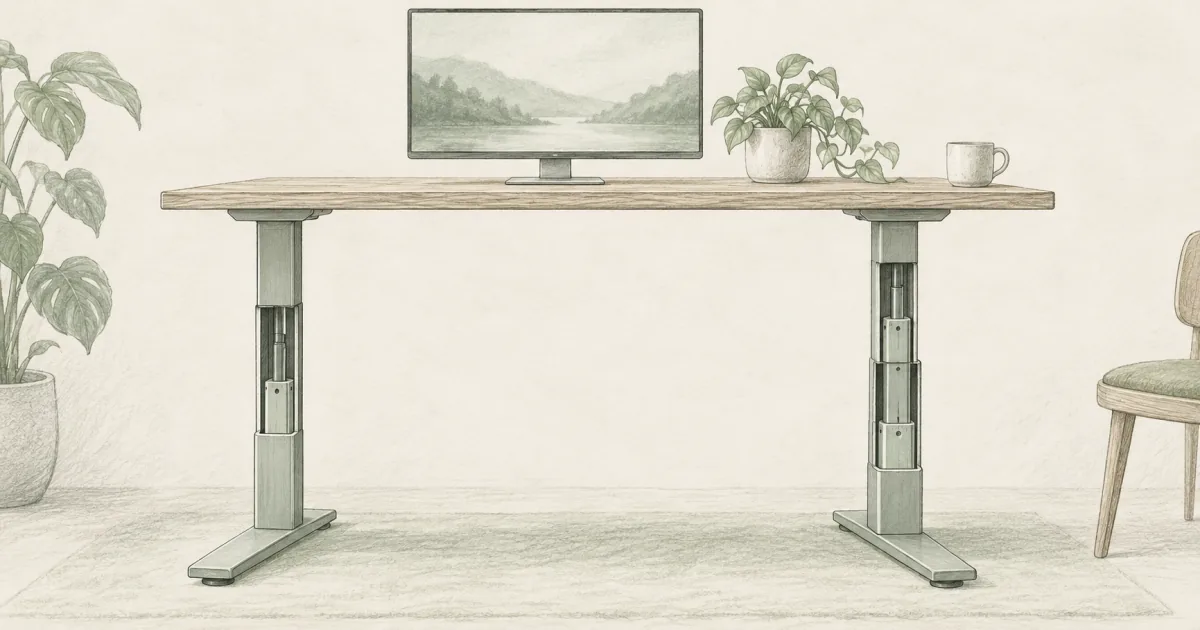
A standing desk's "stage" count is the number of nested leg columns stacked inside the frame. Most home electric desks ship with 2-stage columns because the range covers the average adult. 3-stage frames add a third nested section, which widens travel and keeps the desk sturdier at the top of its lift. The difference shows up in real use at the tall and short ends of the height range, not in the middle.
Cross-shop the rest of the standing desks guides or jump straight to the best standing desk pillar for a wider pick list.
How stage count changes the actual height range
A 2-stage frame has two telescoping leg sections. The outer tube is fixed to the foot, the inner tube carries the crossbar and desktop, and one electric motor drives both legs through a single driveshaft. The trade-off is range: the inner tube has to be long enough to clear the outer tube at the lowest position and short enough to leave room for the desktop at the highest position. Most 2-stage home frames land between 28" and 47".
A 3-stage frame adds a third nested section. The motor drives an intermediate tube, which carries a thinner inner tube that carries the crossbar. The extra section buys two things: roughly 5 to 7 extra inches of total travel, and a stiffer upper section because the inner tube is shorter and less prone to whip at full height. The Flexispot E6 family hits 23.6" at the bottom and 48.8" at the top, which is the wider end of home standing desks.
When a 2-stage desk is enough
A 2-stage frame is the right call when one adult uses the desk, sits between about 5 ft 6 in and 6 ft tall, and switches between sitting and standing two or three times a day. The 28" to 47" range covers seated elbow height for almost everyone in that band, and a 47" top end clears standing elbow height for a 6-footer in normal shoes.
The FLEXISPOT EN1 (B08BHPMYGK) is the strongest 2-stage pick in this batch because the desktop is one piece rather than a spliced board. Most 2-stage desks in the under-$200 band use a desktop that is two pieces joined at the back seam, which flexes more under load and can develop a visible gap after a year or two. The EN1 holds 176 lb, runs quieter than 50 dB, and includes 4 memory presets so a single button press moves between your sit and stand heights.
A 2-stage frame also makes sense for buyers on a tighter budget. The EN1 regularly lands under $120 on Amazon during sales, while 3-stage frames in the same brand family start around $300. The trade is range and a touch of stability at the top, not build quality.
When a 3-stage desk is worth the upgrade
A 3-stage frame earns its keep in three situations: tall users, very short users, and shared desks. The wider range covers a 6 ft 4 in adult who needs close to 49" of standing elbow height, a 5 ft 1 in partner who needs a 24" low end for seated work, and any household that switches between two heights several times a day.
The FLEXISPOT E6 Bamboo 3-Stage Dual Motor (B09DYF1SRQ) is the 3-stage pick we recommend first. The dual-motor design is paired with the 3-stage column, which gives the lift more headroom and keeps the desk more stable at full standing height than a single-motor 3-stage frame.
The 220 lb capacity handles a 27" monitor plus a 24" second screen, a monitor arm, and a laptop with room to spare. The bamboo one-piece top is dense and absorbs vibration, which matters when you type standing up and the desk starts to shake at full height.
The bigger top is the other reason to choose the E6 over a smaller 2-stage desk. The 55" x 28" bamboo surface fits two full-size monitors side by side without crowding the keyboard tray, which a 48" x 24" 2-stage top like the EN1 struggles to do.
Stage count vs motor count
A common confusion is treating "stage" and "motor" as the same thing. They are independent. A 2-stage desk can have a single motor or two motors, and a 3-stage desk can also have either setup. What the motor changes is load capacity and lift smoothness, not the height range.
A dual-motor frame is the right move when you carry a heavy top, a multi-monitor arm, or a CPU mount that stresses one leg more than the other. Single-motor frames keep one side of the driveshaft loaded by gravity, so a heavy top can feel like it leans a little when you lift it. Dual-motor frames split that load and lift more evenly.
The TOPSKY Dual Motor Standing Desk Frame (B08C2LC3H2) is the frame-only upgrade we like for buyers who already have a desktop. It is a 2-stage column with dual motors, 225 lb capacity, anti-collision, and 3 memory presets.
The frame fits tops between 40" and 72" wide and 23.6" to 31.5" deep, which covers most aftermarket and IKEA desktops. The price is roughly the same as a single-motor 2-stage frame with a top included, which is the right way to think about it: you trade the included desktop for a heavier frame.
How tall or short you are changes the math
The reason 2-stage frames stop at about 47" is mechanical. The inner tube has to clear the outer tube at the lowest position. To go higher, the outer tube would need to be longer, which makes the desk too tall to slide under a normal desk at its lowest position. 3-stage frames solve that by adding the intermediate tube.
For users up to about 6 ft tall, a 2-stage frame's 46" to 47" top is enough. For users between 6 ft and 6 ft 5 in, the standing elbow height lands around 48" to 49", which puts the desk at the top of a 2-stage range or the middle of a 3-stage range.
For users over 6 ft 5 in, even a 3-stage frame starts to feel short, and the move is to a 3-stage frame that tops out at 50" or higher, or to a taller non-electric frame that sits at the right height all the time.
For users under 5 ft 4 in, the bottom of the range matters more than the top. A 3-stage frame that starts at 23.6" lets a shorter user sit with their feet flat on the floor and their elbows at the right height. A 2-stage frame that starts at 28" pushes the seat too high for a short user.
The standing desk height guide walks through the elbow-height math in detail. Use it before you choose a stage count, especially if you are over 6 ft or under 5 ft 4 in.
What 3 stage changes for stability
Wobble at full standing height comes from the inner tube flexing under the load you put on the desktop. A 2-stage frame with a long inner tube is more flexible than a 3-stage frame with a shorter inner tube doing the same job. The Flexispot E6 line is the clearest example: a 3-stage E6 at full lift feels noticeably stiffer than a 2-stage EN1 at full lift, even when both are loaded with the same gear.
The wobble difference gets bigger when you add a monitor arm. A 27" monitor on a swinging arm can shift the center of gravity every time you push or pull the screen, and a 2-stage frame will feel that movement more. A 3-stage frame with dual motors damps the same movement better because the inner tube is shorter and the dual motors keep the driveshaft balanced.
Picking the right desk for your space
For one adult between 5 ft 6 in and 6 ft tall, with two monitors on a single arm or one monitor plus a laptop, the FLEXISPOT EN1 two-stage is enough. The single-piece top, 176 lb capacity, and 4 memory presets cover the daily sit-stand job at a friendly price. Browse the best standing desk under 500 guide if you want more 2-stage picks under $200.
For a shared desk, a taller user over 6 ft, or a heavier load with a multi-monitor arm, the 3-stage Flexispot E6 line is the upgrade worth the money. The wider range and the stiffer top make daily switching smoother and keep the desk stable when you stand to type. Pair it with an anti-fatigue mat if you stand for long blocks.
For buyers who want to reuse a desktop they already own, the TOPSKY dual-motor frame is the easiest 2-stage upgrade. Skip the splice-board tops entirely and put the budget into a frame with a longer warranty and a real anti-collision sensor.
Bottom line: A 2-stage desk is the right pick for one adult in the typical home height band. A 3-stage desk is the right pick for tall or short users, shared desks, and heavier loads. Pick the stage count to your body, not your budget, and let the motor count follow from how much gear you plan to put on the top.
Frequently Asked Questions
What is the difference between a 2 stage and 3 stage standing desk?
Stage count is the number of nested leg columns inside the frame. A 2 stage frame has two telescoping sections and usually lands between 28 and 47 inches of travel. A 3 stage frame adds a third nested column, which widens the range to roughly 24 to 49 inches and keeps the desk more stable at the very top of its travel.
Is a 3 stage standing desk better than a 2 stage?
Better only when you actually need the wider range. A 3 stage frame is worth it for households that share one desk between a tall adult and a shorter partner, or for anyone over 6 feet tall whose elbows sit above 47 inches when standing. For a single user in the 5 ft 6 in to 6 ft range, a 2 stage frame covers the sit-stand job at a friendlier price.
Do 3 stage standing desks wobble less?
Usually yes, because the third column reduces the visible leg at the top of travel. The trade-off is a heavier, more expensive frame. Independent reviewers note that some 3 stage frames still flex at full standing height when loaded with dual monitor arms, so the desk itself, not only the stage count, decides wobble.
What height range should a 2 stage standing desk cover?
A useful 2 stage range for most adults is about 28 inches at the bottom (seated elbow height for shorter users) to 46 or 47 inches at the top (standing elbow height for adults up to about 6 feet). Anything narrower will force you to choose between a too-low sitting height or a too-low standing height.
Can a 2 stage standing desk fit tall users?
Some can. A 2 stage frame that reaches 47 inches handles users up to about 6 feet tall. For adults between 6 and 6 ft 5 in, a 3 stage frame with a 48 to 49 inch top end is the easier fit.
Does motor count change between 2 stage and 3 stage?
No. Stage count is about the column design, not the motor. You can find single-motor 2 stage desks (Flexispot EN1, ErGear 48x24) and single-motor 3 stage desks, plus dual-motor versions of each. Dual motors are independent of the column design and mainly help with heavier loads and faster, smoother lifts.
How do 2 stage vs 3 stage frames affect shipping weight?
3 stage frames weigh noticeably more than 2 stage frames because the extra column adds metal. Expect a 3 stage frame to add roughly 10 to 15 pounds over a comparable 2 stage frame. That matters if you move apartments often or need to assemble upstairs.
Are 3 stage standing desks harder to assemble?
The third column adds one extra alignment step during assembly, but the rest of the build is the same as a 2 stage frame. If a single person can put together a 2 stage electric frame in about 30 minutes, expect 40 to 50 minutes for a 3 stage frame.